
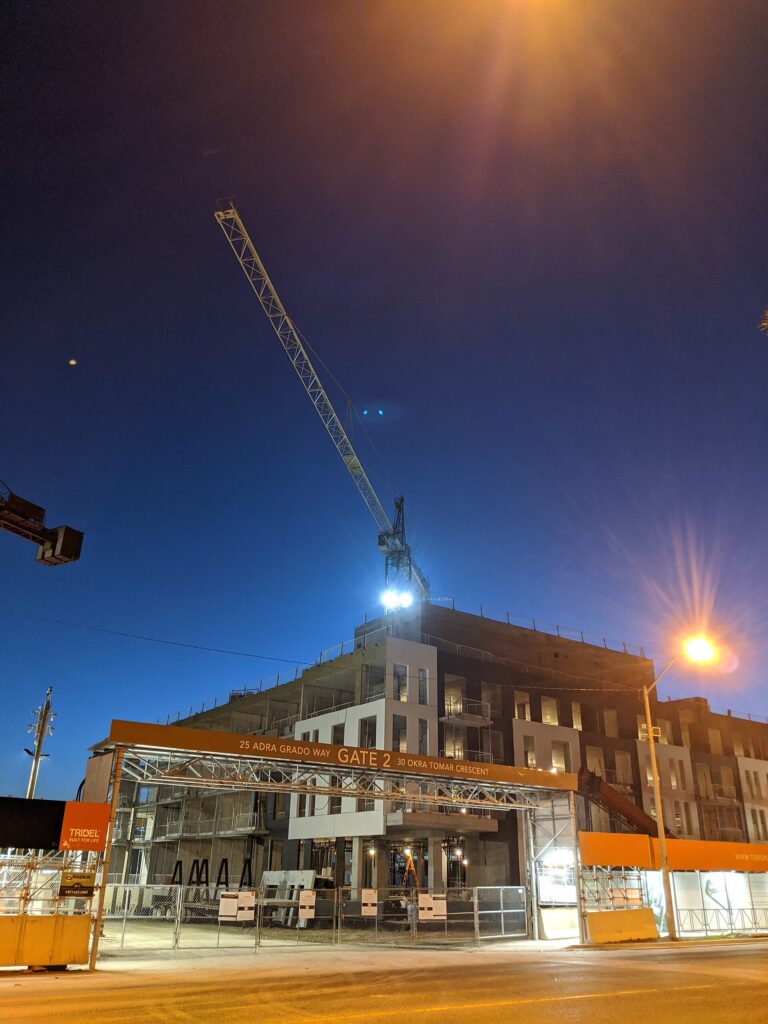
Buying a pre-construction condo in Ontario looks simple at the sales centre: pick a unit, sign the builder’s agreement, wait for it to be built. What the sales staff rarely walk you through in the same detail is what happens in the one to three years between signing and actually owning the unit — the interim occupancy period, and what it takes to sell your spot in line if your plans change before then. Both have real costs that surprise buyers at exactly the wrong moment.
Rules checked October 15, 2026 against the Condo Authority of Ontario and legal/industry sources named below.
Interim occupancy: you move in, but you don’t own anything yet
In Ontario, a new condo building can’t legally transfer title to buyers until the condominium corporation itself is registered with the Land Registry Office — a step that happens only after the building is substantially complete and the final survey, declaration and by-laws are filed. Builders routinely let buyers move in well before that registration happens, through what’s called interim occupancy (sometimes “early occupancy”). You get keys and can live in the unit, but you are not yet the legal owner.
During this period you can’t get a mortgage, because there’s no title to register it against. Instead, the builder charges a monthly interim occupancy fee, and the Condo Authority of Ontario caps what that fee can include: it can be no more than the sum of (1) interest on the unpaid balance of the purchase price, calculated monthly at a rate set out in the agreement, (2) an estimate of the unit’s monthly municipal property taxes, and (3) the unit’s projected monthly common expense (maintenance) fee. You owe this fee whether you actually move in or not.
The part that catches buyers off guard: none of that monthly payment reduces what you owe on closing. It is closer to rent than a mortgage payment — you are paying to occupy a unit you don’t own, while your actual purchase price sits unchanged until final closing. Interim occupancy on a typical Toronto-area project now commonly runs eight months to two years or more, depending on how quickly the builder completes registration, so budget it as a real, multi-month carrying cost on top of whatever housing cost you already have, not a rounding error.
Assignment: selling your contract before you ever close
Plans change over a multi-year build. A job relocation, a change in family size, or simply wanting to realize a gain before final closing leads many pre-construction buyers to consider an assignment — selling your rights under the purchase agreement to a new buyer, who then takes your place and closes with the builder directly. You are not selling the unit itself, because you were never its legal owner; you are selling your contract.
Almost every Ontario builder’s agreement restricts this. Most require the builder’s written consent before you can assign at all, some prohibit it outright until a set point (commonly once the builder has sold a set share of the building’s units, or only during the interim occupancy period once it begins), and the builder’s consent fee for allowing an assignment is set by that builder, not negotiable, and can be significant. On top of the builder’s fee, you’ll typically pay your own lawyer’s fees and the builder’s legal fees for processing the assignment.
A few details that are easy to miss in the excitement of finding a buyer for your contract:
HST applies to most assignment sales. Since May 7, 2022, an assignment of a newly constructed home or condo in Canada is generally a fully taxable supply for HST purposes, on the assignment price (the gain over your original price), unless the deposit you’re being repaid is clearly identified as a separate, non-taxable amount in the assignment agreement. Getting this split wrong in the paperwork can turn a modest profit into a five-figure tax bill on the same transaction.
You may not be off the hook if the new buyer doesn’t close. Builder consent to an assignment usually does not release you, the original purchaser, from the agreement. If your assignee fails to close, the builder can in many cases still come after you unless your assignment agreement with the builder specifically includes a release.
The federal flipping rule can apply to profit on the assignment itself. If you hold the right to the property for less than 365 days before assigning it, any profit is generally treated as fully taxable business income rather than a capital gain (with narrow exceptions for specific life events such as a death, divorce or job relocation) — this is on top of, not instead of, the HST point above.
Land transfer tax lands on the final buyer, not you — but the base it’s calculated on can include the assignment price, and in Toronto the municipal land transfer tax applies as well, so it’s worth both parties confirming the number before the deal closes.
Worth knowing before you sign
- Interim occupancy fees build you no equity at all — they cover interest, estimated taxes and estimated maintenance only, and your purchase price doesn’t change.
- Most builder agreements require written consent before you can assign, and the builder’s own consent fee is not negotiable.
- Assignment profit is generally subject to HST unless your deposit repayment is clearly itemized separately in the agreement.
- Assigning without the required consent can put your deposit at risk, and consenting to your assignment doesn’t automatically release you if your buyer later fails to close.
- Holding the assignment for under 365 days can turn your profit into fully taxable business income under the federal flipping rule.
None of this means interim occupancy or assignment are bad options — both are completely normal parts of buying pre-construction in Ontario. The point is that the sales centre’s job is to get you to sign, not to walk you through what an assignment consent fee or a surprise HST bill looks like two years later. Ask your own real estate lawyer to review the assignment and occupancy clauses in the agreement of purchase and sale before you sign, not after you’ve already moved in.
Related reading: our Down Payment & Mortgage Insurance Calculator and Closing Costs & Land Transfer Tax Calculator can help you plan the cash you’ll need at final closing once interim occupancy ends.
This is general information, not legal or tax advice — assignment and occupancy terms vary by builder and by project, and HST/flipping-rule treatment depends on your specific facts, so have a real estate lawyer and accountant review your own agreement.
Sources: Condo Authority of Ontario — interim occupancy fees · Nihan Law — assignment sales of pre-construction condos in Ontario · Storeys — interim occupancy fee. Rules checked October 15, 2026. Full source list: Sources & Methodology.
Related tools
- Affordability Calculator: how much home your income can support
- First-Time Buyer Step-by-Step: every step from pre-approval to keys
- Documents to Buy a Home Checklist: what lenders and lawyers will ask for
Browse all our free tools and checklists, or find quick answers in our FAQ.