
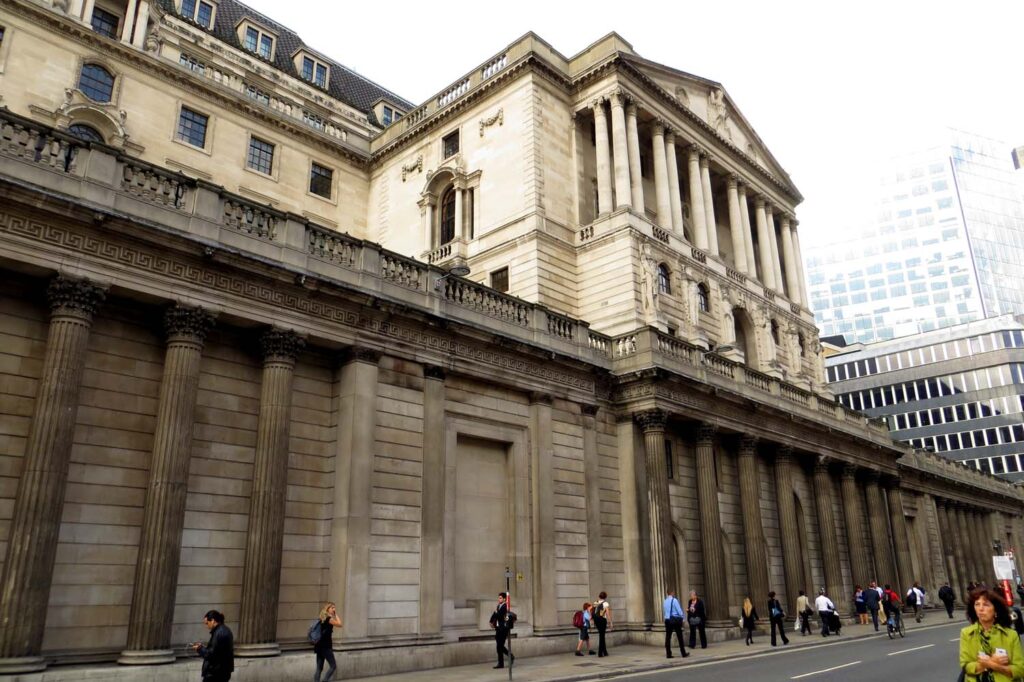
The Bank of England raised interest rates on 5 November 2026, lifting Bank Rate by 0.25 percentage points from 3.75% to 4%. It is the first Bank of England interest rate rise in more than three years. If you have a tracker or variable mortgage, your payments go up within weeks. If you are on a fixed rate, nothing changes until your deal ends, but the rate you remortgage onto has already moved.
Here is what the decision says, who pays more, and what to do about it before the next announcement on 17 December.
What the Bank of England decided, and why
The Monetary Policy Committee voted 8 to 1 for the rise. The one dissenter, Catherine Mann, wanted a bigger move to 4.25%. The reason is inflation: CPI reached 3.5% in the year to September, and the Bank’s own staff now expect it to climb to around 5% by the middle of 2027, driven largely by energy prices, before easing back toward the 2% target.
The minutes are clear that this was not a one-line decision. The Committee says policy is “not on a pre-set path”. Several members, including the Governor, see a case for another rise in the near term unless inflation news softens, while at least one member described this move as one-off insurance. In plain terms, a further increase is a live possibility, not a certainty.
Tracker and variable mortgages: how much more you pay
Tracker mortgages follow Bank Rate directly, usually at a fixed margin above it, so a 0.25 point rise passes straight through. As a rough guide, that adds about £14 to £15 a month for every £100,000 you owe on a typical repayment mortgage.
Worked example. Say you owe £200,000 on a tracker at Bank Rate plus 0.75%, with 25 years left. Your rate moves from 4.50% to 4.75%, and your monthly payment goes from about £1,112 to about £1,140. That is roughly £29 more a month, or about £343 over a year. Lenders normally apply the change from your next payment date or shortly after, and they must write to tell you the new amount.
Standard variable rates (SVRs) are different. Your lender sets them and does not have to follow Bank Rate move for move, but most do raise them after a rise. Moneysavingexpert puts typical SVRs at about 4.9% to 6.9%, which is often well above the best fixed deals. If your fixed rate ended and you rolled onto the SVR without noticing, this is the moment to look.
Fixed-rate mortgages: safe for now, but check your end date
If you are on a fixed deal, your payment does not change until the fixed period ends. The catch is the rate you move onto next. The Bank’s minutes note that benchmark two-year mortgage rates had already risen by nearly 0.5 percentage points since early September, as lenders priced in the hike before it happened. Its Monetary Policy Report also shows mortgage approvals for house purchase falling 8% in the three months to September, to the lowest monthly level since 2023.
So the useful question is not “has my rate gone up today?” but “when does my deal end, and what will I move onto?” Under the Mortgage Charter, most big lenders let existing customers lock in a new deal up to six months before their current one ends, and switch to a better rate if one appears before completion. If your fix ends in the first half of 2027, you can start comparing now. Our guide to product transfer vs remortgage explains which route usually costs less.
What it means if you are buying
Buyers feel this through affordability. Lenders test whether you could cope with a higher rate, so a quarter point rise in the market can trim the maximum loan you are offered, especially at higher loan-to-value. A mortgage in principle issued before 5 November may not hold at the same rate, so ask your broker or lender to recheck it. For a wider view of prices and demand, see our UK housing market 2026 overview.
Savers, at least, get some relief: the best easy-access accounts now pay 4.5% or more, according to Moneysavingexpert, although many banks pass rises on slowly.
To see what a rate change does to your own payment, try our Mortgage Calculator. If you are weighing whether to leave a deal early, the Mortgage Renewal & Penalty Calculator shows the trade-off. The full decision is on the Bank of England’s November 2026 Monetary Policy Report.
Quick questions
When is the next Bank of England interest rate decision?
The next Monetary Policy Committee meeting ends on 16 December 2026, with the decision and minutes published on 17 December 2026.
Will my fixed-rate mortgage go up?
Not during the fixed period. Your payment only changes when the deal ends and you move to a new rate or your lender’s SVR.
How much does a 0.25% rise add to a tracker mortgage?
Roughly £14 to £15 a month per £100,000 borrowed on a 25-year repayment mortgage. Interest-only borrowers pay about £21 more per £100,000.
Related tools: Mortgage Calculator · Mortgage Renewal & Penalty Calculator · Affordability Calculator · All tools & checklists
Sources: Bank of England, Monetary Policy Report November 2026; Bank of England, Monetary Policy Summary and minutes, November 2026 (vote, guidance, next meeting date); Moneysavingexpert, base rate rise coverage, 5 November 2026 (SVR range, savings rates). Figures checked November 10, 2026. The 4% Bank Rate is in force from 5 November 2026; future rises are possibilities discussed by the MPC, not decisions. The £200,000 tracker example is an illustration, not a quote.
This article is general information, not financial or mortgage advice. Speak to a qualified mortgage adviser about your own situation.